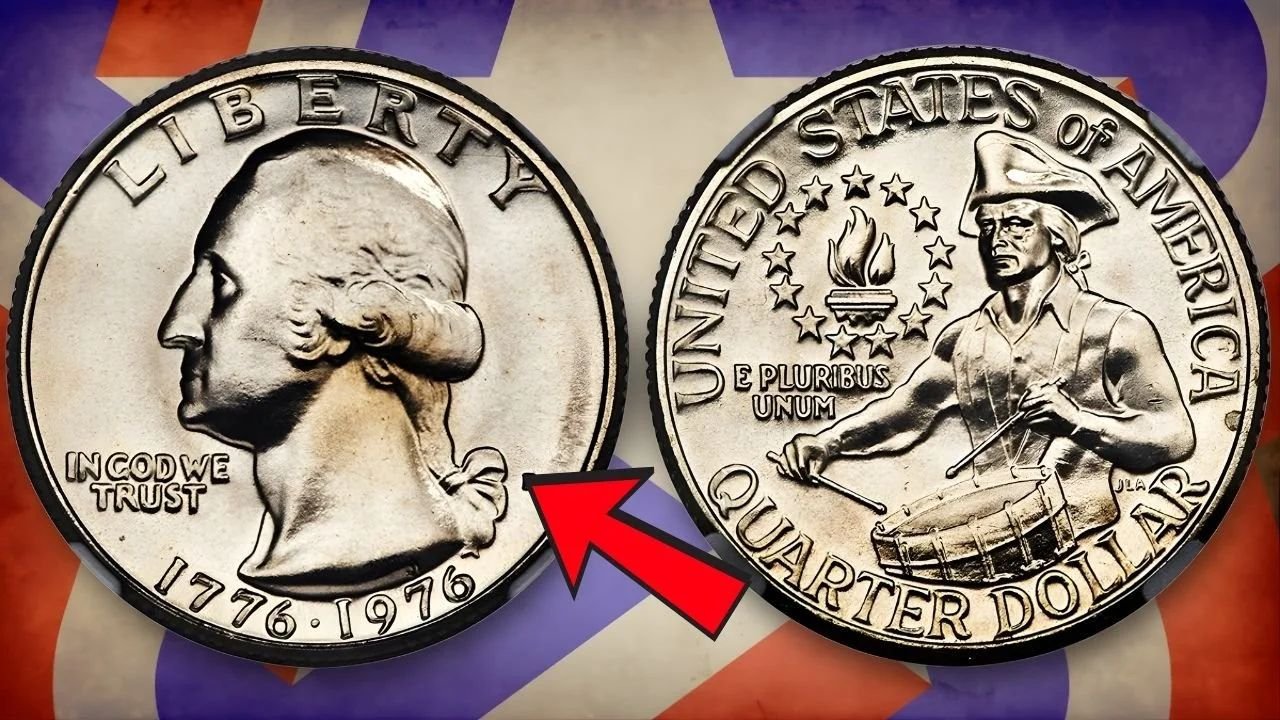
9 Rare Washington Quarters: Among the coins jingling in pockets and filling jars across America, the Washington quarter is a familiar piece of currency. Since its 1932 debut commemorating the bicentennial of George Washington’s birth, this coin has woven itself into the fabric of everyday life. Yet, for some, it represents far more than twenty-five cents. Certain rare dates and intriguing minting mishaps have transformed ordinary quarters into sought-after historical artifacts, with values reaching impressive sums. This exploration highlights nine notable examples, celebrating the meticulous craft of minting and the fascinating stories behind these miniature pieces of history.
The Pioneering 1932-D Washington Quarter
As a first-year issue from the Denver Mint, this quarter holds a special place in numismatic history. With a mintage of just 436,800, it stands as the lowest for the entire series. Its scarcity, combined with its status as an inaugural coin, makes it highly prized by collectors. Identifying it requires a glance at the reverse, where a small “D” mint mark rests below the eagle. Values span a wide range, from about $1,000 for a worn example to an astonishing $50,700 for a specimen in flawless, mint-state condition.
Table of Notable Washington Quarters
| Year & Variety | Mint Mark | Mintage/Notes | Key Identifier | Estimated Value Range |
|---|---|---|---|---|
| 1932-D | D | 436,800 (Lowest Mintage) | “D” on reverse below eagle | $1,000 – $50,700 |
| 1932-S | S | 408,000 | “S” on reverse below eagle | $800 – $35,000 |
| 1943-S Doubled Die Obverse | S | Error Coin | Doubling on “IN GOD WE TRUST” & portrait | $2,000 – $20,000 |
| 1950-D/S Overmintmark | D over S | Error Coin | “S” visible beneath the “D” mint mark | $400 – $5,000 |
| 1950-S/D Overmintmark | S over D | Error Coin | “D” visible beneath the “S” mint mark | $300 – $4,000 |
| 1964-D Doubled Die Reverse | D | Error Coin | Doubled lettering on “QUARTER DOLLAR” | $500 – $7,000 |
| 1970-S Proof on Canadian Planchet | S | Error Coin (On foreign planchet) | May show traces of 1941 Canadian design | $25,000 – $35,000 |
| 1983-P (No Mint Mark) | None | Philadelphia issue lacking mint mark | No “P” mint mark on obverse | $100 – $1,500 |
| 2004-D Wisconsin Extra Leaf | D | Die Variety State Quarter | Extra leaf on corn husk on reverse | $150 – $2,500 |
The Scarce 1932-S Washington Quarter
Struck at the San Francisco Mint in that same inaugural year, the 1932-S is the twin to the 1932-D in terms of rarity. Its mintage was slightly lower at 408,000 pieces, cementing its status as a key coin for any serious collection. Look for the “S” mint mark in the same location on the reverse. While circulated coins start around $800, those preserved in top condition can command prices up to $35,000.
The Distinctive 1943-S Doubled Die Obverse
This coin is a testament to a minting error where the hub imprinted the design onto the die twice, slightly offset. The result is a visible doubling, most noticeable on the inscriptions “IN GOD WE TRUST” and “LIBERTY,” as well as on Washington’s eye and hairline. Originating from the San Francisco Mint, its exact mintage is unknown but certainly low. For collectors of error coins, this is a premier find, with values ranging from $2,000 to $20,000 based on the prominence of the doubling and its state of preservation.

The Layered 1950-D/S Overmintmark
Minting errors often tell a story of correction and adaptation. For this Denver-minted quarter, an “S” mint mark was first punched into the die, then overridden with a “D.” Under magnification, the ghostly outline of the original “S” remains visible beneath the “D.” This layered history makes the coin a fascinating study, with values generally falling between $400 and $5,000.
The Contrasting 1950-S/D Overmintmark
The counterpart to the previous coin, this San Francisco issue features the opposite error: an “S” mint mark punched over a “D.” Collectors enjoy the detective work of spotting the faint “D” lurking underneath. It is a slightly more common error than the 1950-D/S, reflected in a value range of approximately $300 to $4,000.
The Bold 1964-D Doubled Die Reverse
This error from the Denver Mint is notable for its dramatic doubling on the reverse (tails) side of the coin. The inscriptions “UNITED STATES OF AMERICA” and “QUARTER DOLLAR” show clear secondary lettering. As the last year of 90% silver quarters, 1964 issues are popular, and this striking error enhances its appeal, with values from $500 to $7,000.
The Transnational 1970-S Proof on a Canadian Planchet
Perhaps one of the most unusual errors, this proof quarter was struck at the San Francisco Mint on a planchet (blank coin metal) intended for a 1941 Canadian silver coin. Traces of the Canadian design may be visible beneath the Washington quarter imagery. This rare hybrid is a numismatic curiosity, with an estimated value between $25,000 and $35,000 due to its unique nature and proof status.

The Elusive 1983-P Washington Quarter (No Mint Mark)
In 1983, the Philadelphia Mint (which typically uses a “P” mint mark on quarters) produced some coins that entirely lacked this identifier. While not extraordinarily rare, finding one in superb, uncirculated condition is a challenge. These well-struck examples are the ones that attract collector interest, with values from $100 to $1,500.
The Detailed 2004-D Wisconsin “Extra Leaf” Quarter
Part of the state quarters series, this coin features a die variety on the reverse depicting a corn stalk. A small, extra leaf appears on the corn husk, created by a die crack or gouge. There are two recognized varieties: “High Leaf” and “Low Leaf,” depending on its placement. These modern errors are still occasionally found in change, with values ranging from $150 to $2,500.
A Guide to Identification and Appreciation
Discovering a rare coin requires a blend of knowledge, patience, and careful observation. Begin by examining the mint mark, noting its location changed from the reverse to the obverse (near Washington’s portrait) after 1968. Systematically look for errors like doubled lettering, overlapping mint marks, or unusual design elements. The condition is paramount; coins graded Mint State (MS) or Proof are valued significantly higher. Using a magnifying glass or loupe is essential to spot subtle details that distinguish a common coin from a valuable one. Finally, for any potentially valuable find, seek verification from a professional grading service like PCGS or NGC, which can authenticate and grade the coin, providing assurance and maximizing its value.
Frequently Asked Questions
Q: Is it possible to find one of these rare quarters in my everyday change?
A: While chances are slim, especially for pre-1965 silver quarters, it is not impossible. Modern errors like the 2004-D Wisconsin Extra Leaf quarter do occasionally circulate. The thrill of the hunt is part of the hobby’s appeal.

Q: Which Washington quarter is considered the most valuable?
A: The 1932-D quarter holds the record for the highest potential value, with pristine, professionally graded examples selling for upwards of $50,000.
Q: If I believe I have a valuable quarter, where should I go to have it assessed or sold?
A: Start by consulting a reputable local coin dealer or a trusted professional grading service like PCGS or NGC for authentication. For selling, consider established auction houses such as Heritage Auctions or Stack’s Bowers, or reputable online numismatic marketplaces.
Q: Are proof coins a good addition to a collection?
A: Yes, proof coins are specially struck with mirrored backgrounds and frosted designs for collectors. They represent the highest quality of strike from the mint. Proofs with errors, like the 1970-S on a Canadian planchet, can be especially valuable.
These quarters are more than mere currency; they are tangible connections to America’s past, each with its own story. Whether you’re a dedicated collector or simply curious, taking a moment to examine the coins in your possession can be a rewarding journey into history, art, and perhaps, discovery.